
Revista Maskay
E-ISSN 3153-0001
Influencia de la economía pastoril en la estructura social del imperio Wari
Ivan Miranda Vega
Universidad Nacional San Cristóbal de Huamanga, Perú
Carlina Nuria Macizo Cervantes
Universidad Nacional San Cristóbal de Huamanga, Perú
Resumen
Mediante análisis zooarqueológico, isotópico y de infraestructura pastoril, se examina el papel de la economía pastoril en el Estado imperial Wari (600–1000 d.C.). Los hallazgos muestran que los camélidos participaron en la producción de alimentos y fibras, en transporte, la circulación de recursos y prácticas rituales. Asimismo, la especialización productiva, el almacenamiento y el acceso diferencial a bienes de prestigio habrían favorecido la diferenciación social e integración territorial, aunque la articulación entre economía pastoril y poder estatal no fue uniforme ni de control directo.
Palabras claves
Imperio Wari, economía pastoril, camélidos, diferenciación social,
economía política.
Citas
Alaica, A. K., Scaffidi, B. K., González La Rosa, L. M., Jennings, J., Knudson, K. J., y Tung, T. A. (2022). Flexible agropastoral strategies during the 1st millennium CE in southern Peru: Examining yunga Arequipa camelid husbandry practices during Wari expansion through stable isotope analysis (δ13C and δ15N) in the Majes and Sihuas Valleys. Quaternary International.
https://doi.org/10.1016/j.quaint.2022.06.015
Baker, L. J., Alaica, A., Locker, A. J., Krause, M. B., González, L. M., Palacios Gamarra, J., Aramburú Venegas, D. M., & Tung, T. A. (2025). Human-Camelid Interactions in the Wari Hinterlands: A stable isotopic analysis of camelid remains from Auquimarca (600-1000 CE), Huancayo, Peru. https://doi.org/10.1007/s12520-026-02471-z
Bonavia, D. (1996). Los camélidos sudamericanos: Una introducción a su estudio (Nueva ed.). Institut français d’études andines. https://doi.org/10.4000/books.ifea.2616
Castillo, L. J., Fernandini B., F., & Muro Y., L. (2012). Relaciones multidimensionales entre los estados Wari y Moche del norte del Perú. Boletín de Arqueología PUCP, (16), 53–78. https://doi.org/10.18800/boletindearqueologiapucp.201201.004
Earle, T. (1997). How chiefs come to power: The political economy in prehistory. Stanford University Press. https://archive.org/details/howchiefscometop0000earl
Earle, T., & Jennings, J. (2012). Remodelando la economía política del Imperio Wari. Boletín De Arqueología PUCP, (16), 209–226. https://doi.org/10.18800/boletindearqueologiapucp.201201.010
Finucane, B., Agurto, P., e Isbell, W. (2006). Human and animal diet at Conchopata, Peru: stable isotope evidence for maize agriculture and animal management practices during the Middle Horizon, Journal of Archaeological Science, Volume 33, Issue 12. https://doi.org/10.1016/j.jas.2006.03.012
Gibbon, E., Knobloch, P., & Jennings, J. (2022). Complicating an early state: A social network analysis of agents in Wari art (c. AD 700–850). Antiquity, 96(387), 646–661. https://doi.org/10.15184/aqy.2022.53
Grávalos, M. E., Reid, D. A., Nash, D. J., y Williams, P. R. (2022). Crafting Cosmopolitanism: Ceramic Production and Exchange during Wari Imperialism (600-1000 CE). Journal of Anthropological Archaeology, 68, 101438. https://papers.ssrn.com/sol3/papers.cfm?abstract_id=4197824
Isbell, W. H. (2019). Cultural diversity in Middle Horizon Wari: Mortuary practices, ceramic styles, and religious experience. En W. H. Isbell & A. L. M. Rofes (Eds.), Ronshu (pp. 1-30). Research Center for Integrated Area Studies, Nanzan University. https://rci.nanzan-u.ac.jp/jinruiken/publication-new/item/ronshu8_02%20Isbell.pdf
Isbell, W. H., y Cook, A. G. (2002). A New Perspective on Conchopata and the Andean Middle Horizon. En H. Silverman y W. H. Isbell (Eds.), Andean Archaeology II: Art, Landscape, and Society (pp. 249–305). Kluwer Academic/Plenum Publishers.
Isbell, WH (2008). Wari y Tiwanaku: Identidades internacionales en el horizonte medio de los Andes centrales. En: Silverman, H., Isbell, WH (eds.), Manual de Arqueología Sudamericana. (pp. 731–760). Springer, Nueva York, Springer. https://doi.org/10.1007/978-0-387-74907-5_37
Keer, J., y Jennings, J. (2025). Afterglow: Vilca Beer, Pro-Social Feelings, and Wari Geopolitics in the Ancient Andes. Revista de Arqueología Americana, 43, 205-243. DOI / URL: https://doi.org/10.35424/rearam.i43.6051
Laszczka, A. y Prządka-Giersz, P. (2020). Tapestry-Woven Textiles from Castillo de Huarmey, Peru and the Wari-Huarmey Textile Tradition. Estudios Latinoamericanos, 40, 141-164. https://doi.org/10.36447/Estudios2020.v40.art5
Maita Agurto, P., y Pérez Calderón, I. (2011). Informe Arqueozoológico de materiales recuperados en el complejo arqueológico Wari. En Conchopata: revista de arqueología N°3 (pp. 71-123). Universidad Nacional de San Cristóbal de Huamanga.
Meddens, F. M. (2020). Wari women as symbols of power; and a case for client states. Estudios Latinoamericanos, 40, 87-120. https://estudioslatinoamericanos.pl/index.php/estudios/article/download/374/286/
Meddens, F. M., Aramburu Venegas, D. M., Branch, N. P., Fehren-Schmitz, L., Meddens, B. J., & Vivanco Pomacanchari, C. (2024). The cloud people of Naupallacta: Middle Horizon camelid management in the hinterland of the Chicha Soras Valley. Ñawpa Pacha, 45(1), 21–54. https://doi.org/10.1080/00776297.2024.2399428
Murra, J. V. (1975). El control vertical de un máximo de pisos ecológicos en la economía de las sociedades andinas. En Formaciones económicas y políticas del mundo andino (pp. 59-115). Instituto de Estudios Peruanos.
Nash, D. J. (2021). Modelización de los tipos de colonialismo wari a escala regional y residencial. Bulletin de l’Institut français d’études andines, 50(2), 93-116. https://doi.org/10.4000/bifea.13396
Nash, D. J. (2022). Considering imperial complexity in prehistory: A polyethnic Wari enclave in Moquegua, Peru. Humans, 2(3), 104–137. https://doi.org/10.3390/humans2030008
Noe, S. J., McCool, W. C., & Wilson, K. M. (2024). A cross-regional examination of camelid herding practices in Peru from 900 BCE to 1450 CE: Insights from stable isotopes in camelid bone collagen and fiber. PloS one, 19(10), e0306205. https://doi.org/10.1371/journal.pone.0306205
Oakland Rodman, A., & Fernández, A. (2000). Los tejidos huari y tiwanaku: comparaciones y contextos. Boletín De Arqueología PUCP, (4), 119–130. https://doi.org/10.18800/boletindearqueologiapucp.200001.004
Ochatoma Paravicino, J. (2007). Alfareros del imperio Huari: Vida cotidiana y áreas de actividad en Conchopata. Universidad Nacional de San Cristóbal de Huamanga.
Ochatoma Paravicino, J., y Cabrera Romero, M. (2023). Wari: Precursores de los imperios andinos. Fondo Editorial de la UNSCH. https://repositorio.unsch.edu.pe/
Quilter, J., Rengifo, C., Tufinio, M., Zavaleta, E., Oakland, A., Pariona Muñoz, L., Szpak, P., Mieites Alonso, M. G., Shibayama, N., & Maturana-Fernandez, A. (2024). Textiles, dates and identity in the late occupation of the Huacas de Moche, Peru. Antiquity, 98(401), 1359–1375., https://doi.org/10.15184/aqy.2024.138
Rehl, J. W. (2000). The order of things in ancient Peru: Visual metaphors in Wari-associated DWW textiles. Textile Society of America Symposium Proceedings. https://digitalcommons.unl.edu/tsaconf/828
Reid, D. A., Williams, P. R., Cardona Rosas, A., Goldstein, R. C., Dussubieux, L., Banikazemi, C., y Rademaker, K. (2025). Obsidian Procurement and Exchange at the Apogee of Empire: Wari Political Economy in Arequipa, Peru. Latin American Antiquity, 36, 160–180. https://doi.org/10.1017/laq.2023.68
Rosenfeld, SA, Jordan, BT y Street, ME (2021). Beyond exotic goods: Wari elites and regional interaction in the Andes (Antiquity, 95 (380), 400-416. DOI: https://doi.org/10.15184/aqy.2020.250
Schreiber, K. J. (1991). Jincamocco: A Huari Administrative Center in the South Central Highlands of Peru. En W. H. Isbell y G. F. McEwan (Eds.), Huari Administrative Structure: Prehistoric Monumental Architecture and State Government (pp. 199–213). Dumbarton Oaks Research Library and Collection. https://www.academia.edu/18726245/Jincamocco_A_Wari_Administrative_Center_in_the_South_Central_Highlands_1991_
Schreiber, K. J. (1992). Wari imperialism in Middle Horizon Peru. University of Michigan Press.
Schreiber, K. J. (2012). The Wari empire of Middle Horizon Peru. Left Coast Press.
Sulca Huarcaya, N. R. (2024). Investigaciones preliminares en dos centros administrativos wari en la puna de Chipao, provincia de Lucanas, región de Ayacucho. Boletín De Arqueología PUCP, (35), 122–133. https://doi.org/10.18800/boletindearqueologiapucp.202402.006
Tantaleán, H. (2013). Un estado militarista andino llamado Wari. Arkeo Ayacucho. https://arkeoayacucho.files.wordpress.com/2013/02/tantalean_2013_wari_ayacucho_final-libre-1.pdf
Tomczyk, W., Giersz, M., Sołtysiak, A., Kamenov, G., & Krigbaum, J. (2019). Patterns of camelid management in Wari Empire reconstructed using multiple stable isotope analysis: evidence from Castillo de Huarmey, northern coast of Peru. Archaeological and Anthropological Sciences, 11, 1307-1324. https://doi.org/10.1007/s12520-017-0590-6
Wheeler, J. C. (1995). Evolution and present situation of the South American Camelidae. Biological Journal of the Linnean Society, 54(3), 271–295. https://doi.org/10.1111/j.1095-8312.1995.tb01037.x
Whitlock, B., Van Valkenburgh, P., & Wernke, S. A. (2024). Managing pastoral landscapes: remote survey of herding infrastructure in Huancavelica, Peru. Antiquity, 98(397), 229–244. https://doi.org/10.15184/aqy.2023.174
Williams, P. R., Reid, D. A., Grávalos, M. E., Marsh, E., Bélisle, V., Conlee, C., Kerchusky, S., & McEwan, G. (2024). Wari across the Andes: Modeling the radiocarbon evidence. Journal of Archaeological Science: Reports, 52, 104257. https://www.sciencedirect.com/science/article/pii/S1040618224001381
Licencia

Esta obra está bajo una licencia internacional Creative Commons Atribución-NoComercial 4.0.
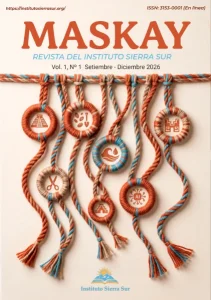
Cómo citar
Miranda Vega, I., & Macizo Cervantes, C. N. (2026). Influencia de la economía pastoril en la estructura social del imperio Wari. MASKAY REVISTA DEL INSTITUTO SIERRA SUR, 1(1), 4–28. https://doi.org/10.5281/zenodo.23222945
Número
- Volumen 1 - N° 1
- Setiembre - Diciembre 2026
- Publicado: 12/10/2026
Sección
- Artículo de investigación